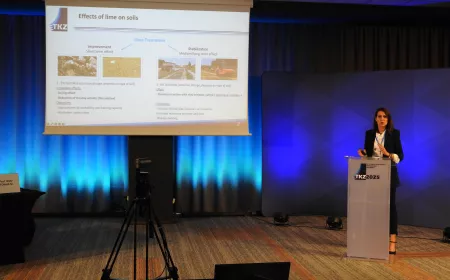
At the XXI Technical Dam Control International Conference in Krakow, Poland, Federica Bertola, Lhoist’s Expert Application Engineer for lime in Civil Engineering, shared new insights about the long-term monitoring of lime-treated hydraulic structures. Discover below her insights and explore the evolving role of lime in hydraulic engineering.
What’s behind the growing interest in lime treatment for hydraulic structures?
"Hydraulic structures such as dikes, levees, and canals have to meet specific functional requirements to ensure their proper operation and keep us all safe. They must resist water seepage, withstand erosion, and endure high flow rates. Over the past two decades, research and full-scale projects have demonstrated that lime treatment can help to achieve these requirements.
Lime treatment is a widely used soil stabilization method in construction that improves workability, load-bearing capacity, and soil strength through chemical reactions triggered by adding quicklime. It enables the use of locally available soils, reducing the need for imported materials and cutting transportation costs. It also simplifies construction designs, while significantly enhancing soil strength, erosion resistance, and overall cost efficiency. Lime treatment has therefore attracted attention from owners, designers, and contractors."
What makes lime-treated soils so effective in these applications?
"One of lime’s key strengths lies in its ability to improve soil workability and mechanical performance. By lowering the plasticity and moisture content of clay-rich soils, lime makes them easier to handle and less prone to swelling or shrinking, leading to more stable and reliable embankments. In addition, the construction of experimental dikes and long-term monitoring of these structures have learned that lime also improves hydraulic functionalities like internal erosion and surface protection."
Does lime treatment affect soil permeability?
"The permeability of the lime-treated soil in the investigated dikes was found to be comparable to that of the untreated soil, approximately 10-9 m/s in the French experimental dikes. The different monitoring campaigns show that the permeability also remains stable over time. To achieve this, specific practices were applied in the construction of the dikes, notably kneading compaction of the lime treated layers with a sheepfoot roller, slightly on the wet site of the Optimum Moisture Content."
Can you explain the science behind lime’s long-term effects?
"Absolutely. Over time, lime reacts with the clay minerals in the soil through a so-called pozzolanic process, forming durable cementitious compounds. This increases the mechanical strength and the resistance to water, frost and erosion, and limits swelling and shrinkage. The process continues slowly to strengthen the soil for decades, as long as there is lime available in the soil matrix, enhancing the long-term durability of the structure."
What insights has long-term monitoring revealed about lime-treated structures?
"We now have over 20 years of experience and monitoring data, engineers have gathered a wealth of data showing the long-term benefits of lime treatment in hydraulic structures. Ongoing monitoring continues to confirm the performance under real exposure conditions over extended periods of time.
A good example of this long-term performance is illustrated by the DigueELITE project, which has provided valuable insights into the durability and erosion resistance of lime-treated hydraulic structures. A comprehensive summary of the project was recently published. It offers very practical guidance to dike owners, designers and contractors."
To conclude, lime treatment has proven to be a reliable and cost-effective solution for enhancing the performance of hydraulic structures. Its ability to improve soil properties, simplify construction, and ensure long-term durability makes it a valuable tool for engineers and project stakeholders. As interest continues to grow, lime treatment is set to play an increasingly important role in building resilient infrastructure for the future.

Contact our experts