Introduction to lime soil treatment
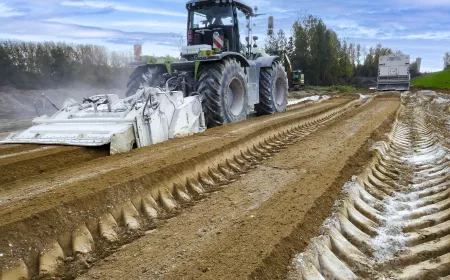
Soil stabilization is a critical process in construction and civil engineering, aimed at enhancing the engineering properties of soil to ensure long-term structural performance. Among the various methods available, lime treatment has emerged as a widely adopted and effective technique. By introducing lime, generally in the form of quicklime (CaO), into the soil, chemical reactions are triggered that significantly improve the soil’s workability, load-bearing capacity, and strength. It reduces soil plasticity and improves soil texture, making the material easier to handle and compact.
Benefits of lime treatment in hydraulic structures
Extensive research, investigation, and construction of full-scale dikes have demonstrated the significant benefits of lime treatment in hydraulic engineering. The acquired scientific knowledge now supports the broader adoption of this technique in practical applications. To better understand how lime treatment supports hydraulic structures, its benefits can be categorized as follows:
Workability:
-
a rapid drying effect, as quicklime binds with excess moisture in the soil,
-
reduced plasticity and improved soil texture, facilitating easier compaction and handling
Stability:
-
development of cementitious compounds that strengthen the soil over time,
-
formation of a more cohesive soil matrix and increase of mechanical strength, improving slope stability and resistance to deformation,
-
reduced shrink-swell behavior, minimizing volumetric changes and cracking.
Hydraulic properties:
-
Low permeability, comparable to the untreated soil and remaining stable over time, preventing water seepage,
-
increased resistance to internal erosion, with a significantly delayed initiation of erosion and a reduced erosion rate,
-
increased resistance to external erosion, offering surface protection against water flows and wave overtopping even after years of exposure
Case study: the DigueELITE Project
Initiated in 2014, the DigueELITE research program focused on the construction and monitoring of an experimental dike along the Vidourle River in France. Lime soil treatment was used as a key component in the design of the dike. Throughout the years, various test campaigns have been conducted to evaluate the behavior and the erosion resistance of the dike.
Following the recent conclusion of the DigueELITE project, the consortium, composing ISL, INRAE, Lhoist, EDF, and ARCOR Technologies - has published a comprehensive summary of the project. This publication consolidates the key findings of the DigueELITE research program, along with insights from related studies, and makes them available for the hydraulic engineering community.
The DigueELITE project summary
This very practical document is intended for project owners, project managers, design offices, construction companies, and control bodies involved in the design, construction, inspection, and monitoring of river dikes and levees, small reservoirs, and hydraulic canals constructed with lime-treated soils, up to a maximum height of 15 meters.
The publication supplements existing design and construction rules by highlighting new technical and economic opportunities. It provides:
-
Detailed guidance on the study, design, dimensioning, construction, and monitoring of lime-treated hydraulic structures
-
In-depth exploration of the technical principles and methodologies behind lime soil treatment in the construction or rehabilitation of hydraulic structures
-
Practical recommendations for both new builds and rehabilitation projects
By integrating these insights, as construction professionals you can contribute to the development of performant, durable hydraulic structures.