Where does flue gas come from?
Flue gas consists of the gases and fly ash emitted during the combustion process in industrial facilities such as power plants, cement kilns, waste incinerators, and metal smelters. It typically contains a mix of gases and particulates, including:
- Sulfur oxides (SO2, SO3)
- Nitrogen oxides (NOₓ)
- Hydrochloric acid (HCl)
- Hydrofluoric acid (HF)
- Heavy metals and organic micro-pollutants
These emissions must be treated before release to comply with environmental regulations and protect public health.
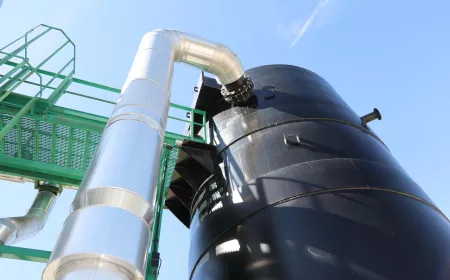
Why does flue gas treatment matter?
Flue gas treatment (FGT) involves technologies that remove harmful substances from industrial exhaust gases. These pollutants can impact both health and the environment, so effective treatment is essential for meeting regulations and supporting sustainable operations. It helps to:
- Meet air quality standards
- Reduce environmental impact
- Enhance plant efficiency and safety
How is flue gas treated?
Flue gas is treated using systems that inject reactive sorbents, such as lime or calcium carbonate into the exhaust stream. These sorbents neutralize acid gases and capture pollutants. The reaction by-products are then removed via filters or scrubbers. Key benefits include:
- High removal efficiency
- Flexibility across fuel types and plant designs
- Reduced maintenance and operational costs
Flue gas cleaning systems vary depending on the industry and pollutants involved. Common systems include:
-
Dry processes, such as Dry Sorbent Injection (DSI), Circulating Dry Scrubber (CDS), and Furnace Sorbent Injection (FSI) involve injecting a dry lime- or mineral-based sorbent directly into the flue gas stream to neutralize acidic pollutants or micropollutants, with residues captured downstream in filters. Specific mineral blends can be also used to decrease fouling and slagging phenomenons in the boiler.
-
Semi-wet processes use a lime slurry (milk of lime) sprayed into hot flue gas; the water evaporates, leaving reactive dry particles that bind with acid gases before being collected as dry residues.
-
Wet processes cool the flue gas and pass it through a scrubbing liquid, where acidic gases dissolve and react with an alkaline sorbent, achieving high removal efficiency with minimal sorbent consumption.
-
Combined processes integrate multiple flue gas treatment technologies such as dry injection with wet scrubbing to enhance overall removal efficiency and adapt to complex emission profiles. These hybrid systems offer flexibility and optimized performance for facilities facing varied pollutant loads.
At Lhoist, our flue gas treatment solutions rely on efficient lime-based products, including quicklime, hydrated lime, and limestone to neutralize acidic pollutants. Each system is designed to enhance reaction performance and pollutant capture, supporting consistent emission control across diverse industrial processes.
What is the benefit of using lime in flue gas treatment?
Hydrated lime (Ca(OH)2) plays a central role in flue gas treatment, complemented by quicklime (CaO) and calcium carbonate (CaCO3), due to their:
- High reactivity with acid gases
- Cost-effectiveness and availability
When injected into flue gas streams, lime-based sorbent reacts with acidic compounds to form stable salts. This neutralization process is efficient and adaptable to various operating conditions.
Sorbacal®: tailored lime solution
To meet the evolving demands of flue gas treatment, across dry, semi-wet, wet, and combined systems, Lhoist has developed specialized lime-based solutions designed for diverse industrial applications. These solutions are reflected in our Sorbacal® product range.
Engineered for high reactivity and optimized particle characteristics, Sorbacal® products like Sorbacal® SP and Sorbacal® SPS deliver superior performance in capturing acidic pollutants such as SO2, HCl, and HF. Their enhanced surface area and porosity significantly increase contact efficiency, allowing for lower sorbent consumption and reduced operational costs.
Flue gas treatment plays a vital role in reducing industrial emissions and protecting environmental and human health. By leveraging the proven reactivity of lime-based products, especially through advanced solutions like Sorbacal®, industries can meet stringent air quality standards while optimizing operational efficiency.
Frequently Asked Questions (FAQs)
What is a flue gas treatment system?
A flue gas treatment system refers to the equipment and processes used to manage and clean exhaust gases from industrial combustion. It typically includes injection units, scrubbers, filters, and monitoring systems tailored to the need of the plant.
Why is hydrated lime (Ca(OH)2) used in flue gas treatment?
Hydrated lime is highly effective at neutralizing acidic gases due to its chemical reactivity. It is cost-efficient, and forms harmless by-products, making it a preferred choice for sustainable emission control.
What is flue gas cleaning?
Flue gas cleaning is the process of removing contaminants from industrial exhaust gases. It involves chemical reactions between pollutants and sorbents, often lime-based, that convert harmful compounds into stable residues.
Ready to optimize your FGT system?
Our specialists are here to help you choose the right product and process for your industrial needs.
Get in touch with our experts