The challenge
The Reims Waste-to-Energy plant operated by Veolia has 2 kilns (6.5 t/h) and valorize household waste and ordinary industrial waste.
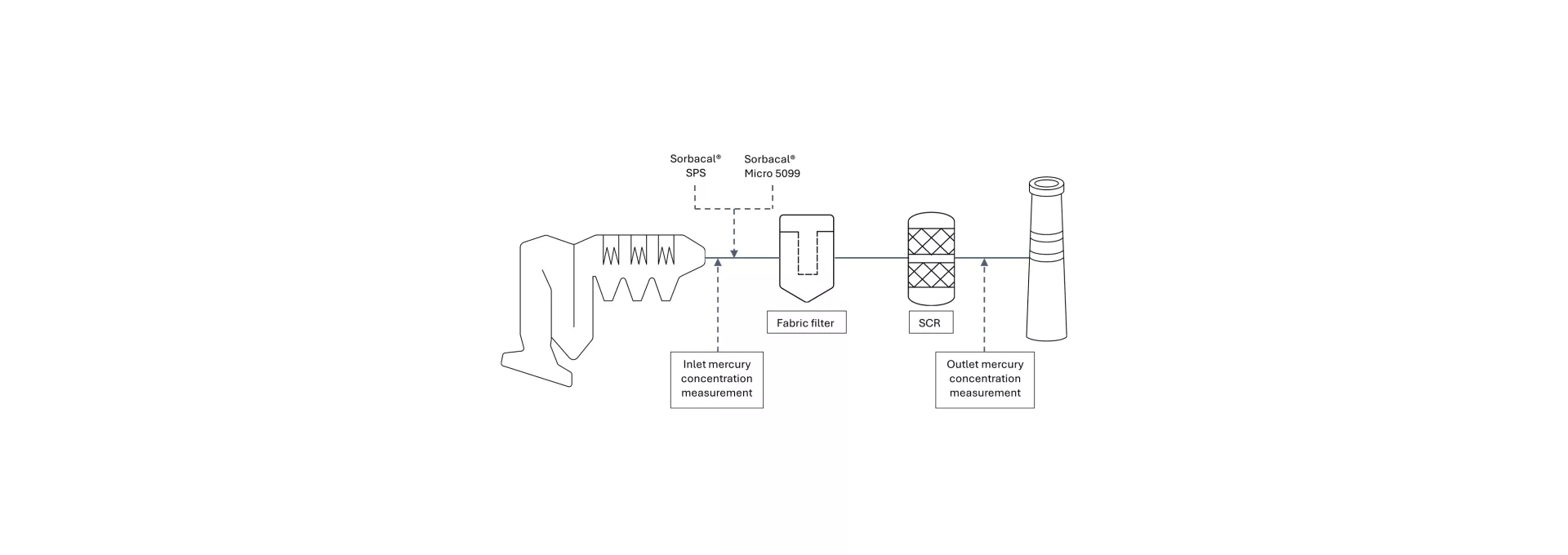
The site is equipped with a dry flue gas treatment consisting of an injection of Sorbacal® SPS for the abatement of acid gases and Sorbacal® Micro 4099 for micropollutants upstream of a baghouse filter with operating temperatures between 180 and 220°C
As part of the application of the BAT (Best Available Techniques) conclusions of the last BREF on waste incineration, the operator asked us to help him determine a reliable solution for compliance with future Emission Limit Values (ELVs) of dioxins/furans and mercury.
The Lhoist solution
In order to meet Rémival's expectations, Lhoist recommended the injection of Sorbacal® Micro 5099.
This non-ATEX reagent was developed by Lhoist for the reduction of dioxins/furans and enhanced mercury capture.
In order to evaluate the performance of the reagent, mercury analyzers were installed on-site for a month and made it possible to determine the:
- Concentration and speciation of mercury upstream of the injection of Sorbacal® Micro 5099
- Concentration of total mercury stack emissions
During these tests, the dosing rate, defined according to the operating conditions, was preserved and kept constant at a value of 0.9 kg of reagent per ton of waste.
The benefits
During the measurement period, the average mercury reduction rate was above 90% for an average concentration upstream of 153 µg/Nm3 (on dry gases at 11% O2).
Higher daily averages (up to 450 µg/Nm³) and numerous mercury peaks (close to 1,000 µg/Nm³) were easily controlled by the dosage of Sorbacal® Micro 5099.
As expected, mercury in ionic form represented at least 85% of the total mercury.
Monthly analysis of the sampling cartridges also confirmed compliance with dioxins & furans emissions.
Sorbacal® Micro 5099 meets the needs of the Rémival site operator.
Indeed, the use of this reagent not only makes it possible to maintain the downstream mercury concentration at a value of around 10 µg/Nm³ (at 11% O2 on dry gases) but also to respect the ELVs for dioxins and furans.